

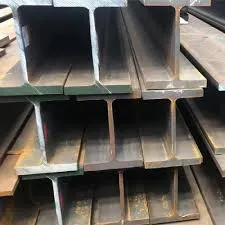
Is an H beam stronger than an I beam?
Short answer: there is no single “stronger” section — the answer depends on the load direction, and stating otherwise is the most common mistake in beam selection.
- Bending about the strong axis, with the compression flange laterally restrained** — an I-beam is usually the more efficient section per kilogram of steel, because more of its material sits far from the neutral axis for the same weight.
- Columns, biaxial bending, torsion, or members receiving framing from two directions** — an H-beam (wide-flange, parallel-flange) is markedly stronger, because its wide flanges raise stiffness about the weak axis and resist lateral-torsional buckling.
This matters in practice: substituting an H-beam for an I-beam on the assumption that it is “stronger” can add tonnage without adding capacity, while substituting it on a column where weak-axis stability governs can do the opposite. The section is selected from section properties and the governing design code — not from the shape of the letter.
The comparison below sets out where each profile wins, and the rest of this article explains the geometry behind those results.
| Selection criterion | Better choice | Why |
| Bending about strong axis only, laterally restrained | I-beam | More material mass placed far from the neutral axis per kg of steel |
| Column / compression member | H-beam | Higher radius of gyration about both axes; resists buckling |
| Biaxial bending, wind, seismic, torsion | H-beam | Wide parallel flanges raise weak-axis stiffness and torsional constant |
| Bolted connections, fast erection | H-beam | Parallel flange faces; no taper to detail around |
| Short span, light load, cost-driven | I-beam | Lower cost per tonne; tapered flange is simpler to roll |
| Span beyond the rolled range | Welded H-beam | Fabricated sections are not limited by mill roll sizes |
| Existing structure in I-beam, extending it | Match existing | Substitution needs engineer verification of section modulus and connections |
1. Structural Differences Between H-Beams and I-Beams
Both H-beams and I-beams are structural steel beams with a cross-section resembling the letter “H” or “I,” but their geometry differs significantly:
- I-Beam: An I-beam typically has a cross-section with a narrower flange (the horizontal parts) compared to its web (the vertical part connecting the flanges). The flanges of an I-beam are often tapered, meaning they are thicker near the web and thinner at the edges. This design makes I-beams lighter and more economical for certain applications but can limit their load-bearing capacity under heavy or complex loads.
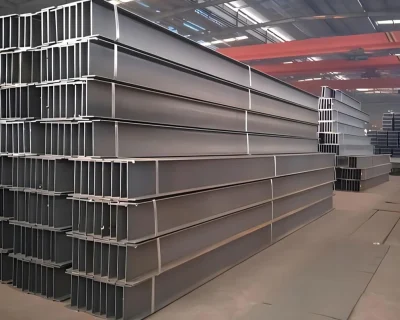
- H-Beam: An H-beam, by contrast, has wider flanges that are typically of uniform thickness and often equal in width to the height of the web. This creates a more robust cross-sectional profile, resembling a true “H” shape. The wider flanges and thicker web contribute to a larger cross-sectional area, which generally enhances the beam’s ability to resist bending and shear forces.
2. Strength Comparison
The strength of a beam is determined by several factors, including its moment of inertia (a measure of resistance to bending), section modulus (a measure of bending strength), and the material properties (typically steel with a specific yield strength). Here’s how H-beams and I-beams compare:
- Moment of Inertia: The moment of inertia (I) quantifies a beam’s resistance to bending. H-beams, with their wider flanges, typically have a higher moment of inertia compared to I-beams of similar height. This is because the wider flanges place more material farther from the beam’s neutral axis, increasing resistance to bending. For example, a typical H-beam might have a moment of inertia significantly higher than an I-beam of the same depth, making it better suited for resisting bending under heavy loads.
- Section Modulus: The section modulus (Z) relates to the beam’s capacity to handle bending stress. Since H-beams generally have a larger cross-sectional area and wider flanges, their section modulus is higher, allowing them to withstand greater bending moments before yielding.
- Shear Resistance: H-beams often have a thicker web compared to I-beams, which enhances their ability to resist shear forces (forces that act parallel to the beam’s cross-section). This makes H-beams more suitable for applications where shear forces are significant.
- Torsional Resistance: H-beams, with their wider and more symmetrical flanges, are generally better at resisting torsional (twisting) forces compared to I-beams, which can be prone to twisting under certain load conditions due to their narrower flanges.
3. Material and Load Conditions
Both H-beams and I-beams are typically made from structural steel (e.g., ASTM A36, A992, or similar grades), so material strength is usually comparable unless specified otherwise. However, the strength of a beam is highly dependent on the specific loading conditions:
- Point Loads vs. Distributed Loads: H-beams are often preferred for heavy point loads (e.g., supporting a column) due to their robust cross-section. I-beams may suffice for uniformly distributed loads (e.g., floor joists) where weight savings are a priority.
- Span Length: For longer spans, H-beams are generally stronger because their higher moment of inertia reduces deflection (sagging) under load. I-beams may deflect more unless specifically designed with a deeper web.
- Lateral Support: If a beam lacks sufficient lateral bracing, it may buckle under compressive forces. H-beams, with their wider flanges, are less prone to lateral-torsional buckling compared to I-beams.
4. Practical Applications
The choice between an H-beam and an I-beam often depends on the specific engineering requirements:
- H-Beams: Commonly used in heavy-duty applications such as high-rise buildings, bridges, and industrial structures where large loads and long spans are involved. Their robustness makes them ideal for columns and beams in frameworks that require high strength and stability.
- I-Beams: Often used in lighter construction, such as residential buildings, warehouses, or smaller commercial structures. Their lighter weight and lower cost make them attractive for projects where extreme strength is not required.
5. Quantitative Comparison
To provide a concrete example, consider two beams of the same height (e.g., 12 inches) and material (e.g., A36 steel with a yield strength of 36,000 psi):
- A typical W12x50 H-beam (wide-flange beam, often referred to as an H-beam in modern standards) might have a moment of inertia of approximately 400 in⁴ and a section modulus of about 65 in³.
- A comparable S12x50 I-beam (standard I-beam) might have a moment of inertia of around 300 in⁴ and a section modulus of about 50 in³. In this case, the H-beam’s higher moment of inertia and section modulus indicate it can resist greater bending moments and deflections, making it “stronger” for most structural purposes.
However, the exact strength comparison requires detailed calculations based on the beam’s dimensions, material properties, and the specific load case (e.g., using formulas like M = σZ for bending stress or δ = PL³/(48EI) for deflection).
6. Limitations and Considerations
While H-beams are generally stronger, they are also heavier and more expensive due to the additional material. This can make I-beams more cost-effective for applications where the loads are within their capacity. Additionally, the design of the structure (e.g., connections, bracing, and load distribution) plays a critical role in determining which beam is more suitable.
In most cases, an H-beam is stronger than an I-beam due to its wider flanges, higher moment of inertia, and greater section modulus, which provide superior resistance to bending, shear, and torsional forces. However, the term “stronger” is context-dependent, and the choice between an H-beam and an I-beam should be based on detailed engineering analysis, considering factors like load type, span length, lateral support, and cost constraints. For precise applications, consulting a structural engineer and performing calculations (e.g., using beam design software or standards like AISC) is essential to ensure the selected beam meets the project’s requirements.
Frequently asked questions
- Which is stronger, an H-beam or an I-beam?
Neither is universally stronger. Per kilogram of steel, a deeper I-section is more efficient in one-direction bending; an H-section is stronger in biaxial bending, compression and torsion because of its wide parallel flanges. The governing factor is the load direction and the unbraced length, not the profile name. - Can an H-beam replace an I-beam directly?
Only after the section properties are checked. An H-beam of equal depth usually has a much larger weak-axis modulus, so it is rarely a like-for-like swap on weight. Verify section modulus, moment of inertia, connection geometry and bracing assumptions with the project engineer. - Are H-beams heavier than I-beams?
At the same nominal depth a wide-flange section generally carries more steel per metre. Comparing the two on mass alone is misleading — the correct comparison is load carried per tonne of steel. - What steel grades are used for structural beams?
ASTM A36 / A992, EN 10025-2 S275/S355, JIS SS400/SM490, and GB/T Q235B / Q355B. Where welded H-sections are used, the plate grade is selected to match the design strength; confirm the grade and mill certificate (EN 10204 3.1 where specified) at order stage.

 English
 Español
 Русский
 العربية
 Français
 Português