

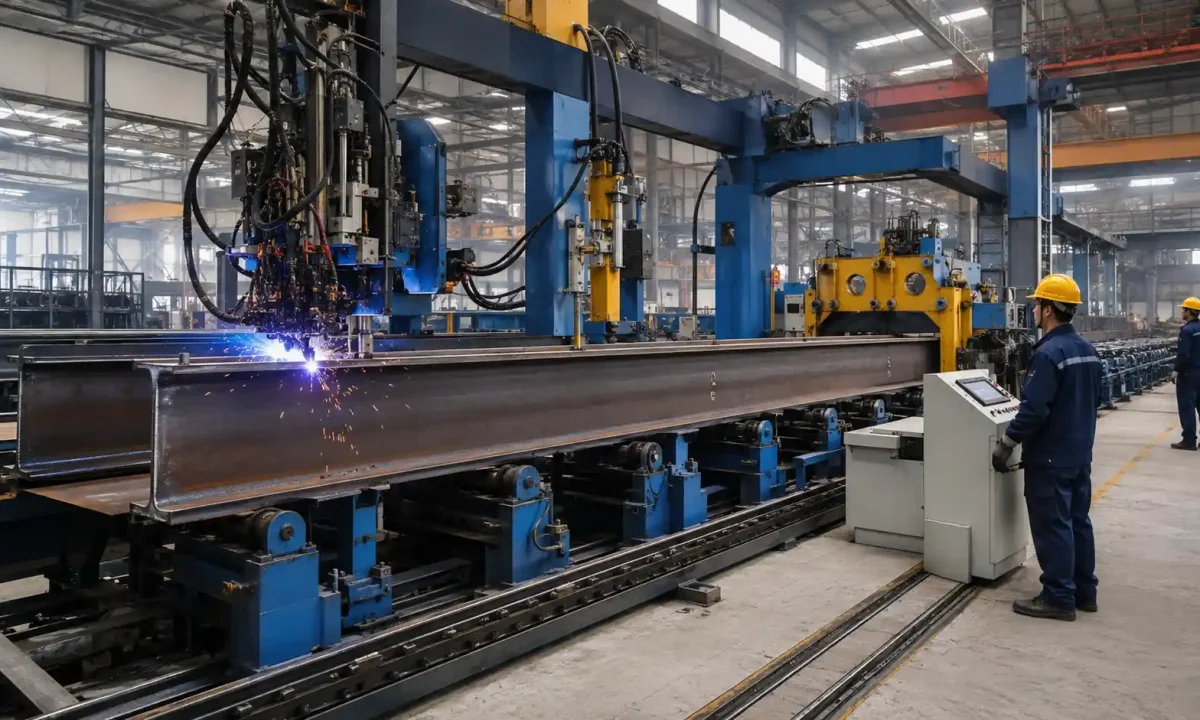
How to Select the Right 3-in-1 H Beam Machine for Your Operation
Introduction
Once the decision to adopt a 3-in-1 machine is made, the real challenge begins: equipment from different manufacturers varies enormously in specification, and quotations can differ by multiples. The cost of choosing wrong cuts both ways — under-specifying means the machine cannot cover your product range, constraining the line from day one; over-specifying means paying a premium for capability you never use, diluting your return on investment.
The correct selection path does not start from the specification sheet. It starts from your own production profile: what specifications you produce, how many pieces per day, who operates the equipment, and how your product mix will change over the next three to five years. Answer these questions clearly, and the choices on the specification sheet resolve themselves.
This article provides a complete framework for how to choose a 3-in-1 H beam machine — six core decision dimensions plus a pre-inquiry checklist, translating your production profile into equipment parameters.
Quick Checklist
| Decision Dimension | The Question You Need to Answer | Corresponding Equipment Parameter |
| Product specifications | What is your primary H beam section height and plate thickness range | Web height range, plate thickness range |
| Output target | How many pieces per day | Welding speed, feed speed |
| Bevel-free requirement | Is web thickness concentrated below 18mm | Bevel-free welding capability |
| Quality requirements | How strict is your flange perpendicularity tolerance | Hot straightening module configuration |
| Team situation | What is your operating team’s skill level | Automation level (semi-auto / full-auto / CNC) |
| Future planning | How will specifications and volume change in 3–5 years | Parameter margin, expansion capability |
Start From Product Specifications: Defining the Coverage Range
Primary Specifications vs Boundary Specifications
The first step in selection is mapping your product specification distribution. List the H beam specifications you have actually produced over the past one to two years and calculate each specification’s share of output. Two key numbers emerge:
Primary specification range — the range covering 70–80% of your output. Equipment parameters must fully cover this range and deliver peak production efficiency within it.
Boundary specifications — the largest and smallest specifications you occasionally produce. These define the upper and lower parameter limits you need, but they should not dominate the selection. Configuring an entire machine’s capability ceiling around a specification that represents 5% of output is rarely economical.
Setting Reasonable Specification Margin
Equipment range should extend beyond your primary specification range — but more margin is not automatically better. The sound approach is to leave one to two specification grades of headroom above your primary range, covering foreseeable product upgrades. For special orders beyond that range, evaluate subcontracting feasibility rather than paying for full-machine capability to serve them.
Start From Output Targets: Matching Speed Parameters
Calculating Capacity Requirements Correctly
A daily output target cannot be equated directly to theoretical cycle time multiplied by working hours. Real production scheduling absorbs changeover time, loading and unloading transitions, quality sampling, and maintenance windows. Effective production time typically runs 70–85% of planned time.
For a target of 30 pieces per day on a single 8-hour shift: at 75% effective time, roughly 6 hours are genuinely productive, meaning the complete cycle per piece must stay within 12 minutes. That is the number to check against the machine’s welding and feed speed parameters — not the shift length on paper.
Verifying Speed Parameters
Welding speed is the primary cycle bottleneck. When verifying, distinguish between the manufacturer’s maximum rated speed and typical working-condition speed — actual welding speed varies significantly across plate thicknesses. Require the manufacturer to provide actual speed data for your primary specifications, not the peak figure from the specification sheet.
Bevel-Free Welding Capability: Whether You Need It and How to Verify It
If your web plate thickness is concentrated in the 12–18mm range, bevel-free welding capability should be treated as a required configuration — it eliminates the groove preparation step entirely, with quantifiable cost reduction. Two verification points matter:
The reality of the thickness limit. Require the manufacturer to state the reliable upper thickness limit for bevel-free full penetration, supported by the corresponding welding parameter scheme and penetration test reports — not just a number on a specification sheet.
Applicability to your steel grades. Bevel-free parameters for standard structural steels such as Q235 and Q345 are relatively mature. If you use high-strength steels, require process validation for your specific grades — do not assume transferability.
For factories where web thickness generally exceeds 18mm, bevel-free capability delivers limited value. Reduce its selection weight and shift budget priority toward welding power capacity and straightening pressure instead.
The Hot Straightening Module: Quality Requirements Determine Configuration Level
The value of the hot straightening module scales directly with your quality requirements:
Product lines with strict tolerances — bridge components, heavy industrial structures, export orders. The batch consistency improvement from hot straightening translates directly into pass rates. These factories should confirm hot straightening as standard configuration and verify that the correction pressure rating covers their maximum plate thickness.
Product lines with conventional tolerances — hot straightening still delivers value through lower roll wear and less rework, but its configuration priority can yield to capacity parameters.
One key question when verifying the hot straightening module: does the distance between the welding station and straightening station, combined with the feed speed, match the hot straightening window for your primary specifications? This question quickly reveals a manufacturer’s depth of understanding of the hot straightening process. A manufacturer who cannot answer it may be offering “hot straightening” as marketing language rather than engineered capability.
Automation Level: Matching Your Operating Team’s Reality
The choice between semi-automatic, fully automatic, and fully automatic CNC configurations hinges not on budget, but on your operating team and management system:
Experienced team, varied specifications — the flexibility of a semi-automatic configuration has genuine value. Skilled operators making manual adjustments are not necessarily slower than automated systems in high-changeover contexts.
New team, or concentrated specifications — the parameterized control of a fully automatic configuration reduces dependence on individual skill. Training cycles for new teams are shorter, and quality stability is better protected.
Quality traceability requirements — export orders and major projects often require production data records. The data logging and traceability functions of a CNC configuration are not a bonus in these contexts; they are an entry requirement.
A common selection error is jumping to the highest automation level before the team is ready — capability goes underutilized and the premium is wasted. Automation level should upgrade in step with management capability, not ahead of it.
The Pre-Inquiry Checklist
Approaching manufacturers with clear requirements produces fundamentally better proposals. Before requesting quotations, confirm you have prepared:
- Primary H beam specification list (section height, web thickness, flange thickness, length) with output share per specification
- Daily output target and shift schedule
- Steel grades used, including any high-strength grades
- Tolerance requirements for key quality metrics such as flange perpendicularity
- Available facility length, width, and crane capacity
- Operating team headcount and experience level
- Foreseeable product mix changes over the next 3–5 years
In parallel, require each manufacturer to provide: actual welding speed at your primary specifications, validation data for the bevel-free thickness limit, the welding-to-straightening transition parameters, and delivery references from customers with comparable specifications. Comparing manufacturers against a single requirement set makes the differences immediately visible.
Conclusion
Selecting a 3-in-1 machine is fundamentally the process of translating your production profile into equipment parameters. Specification distribution determines coverage range, output targets determine speed parameters, quality requirements determine hot straightening configuration, and team reality determines automation level. When every decision has a clear starting point, the selection is no longer driven by specification sheets and quotations. For a complete technical overview of the equipment itself, see our [H beam assembly welding straightening machine complete guide].
ZMDE provides tailored 3-in-1 machine configurations for factories across different production scales and product structures. If you are in the selection stage, contact the ZMDE technical team for configuration recommendations and proposal comparisons based on your production profile.
 English
  Español
  Русский
  العربية
  Français
  Português