
Welding Safety: Avoid Overly Long or Coiled Welding Cables – Maintain Power and Arc Stability (WeldSafe Essentials 15)
Welding cables—especially the electrode and work leads—are designed for flexibility, but excessive length or tight coiling can seriously degrade performance and safety. In WeldSafe Essentials #15, we address why cables should never be used excessively long or left coiled during operation, and how to select the right length based on your job to ensure reliable arc starting, consistent output, and stable welding.
The Dangers of Long or Coiled Cables
1. Coiled Cables (Especially Wire Feeder / Torch Cables)
- Tight coils increase inductance and resistance dramatically.
- This causes:
- Неустойчивая дуга — Voltage fluctuations lead to flickering, spatter surges, and inconsistent penetration.
- Wire feeding issues — Higher resistance in the liner, resulting in stubbing, burn-back, or erratic speed.
- Overheating — Concentrated current in coils can warm the cable excessively, degrading insulation over time.
2. Excessively Long Cables
- Every extra meter adds resistance (typically 0.02–0.05 Ω per 10 m for standard copper cable).
- Consequences include:
- Reduced output power — Lower voltage at the arc means weaker welds, especially at higher amperages.
- Poor arc starting — Difficulty striking or maintaining the arc, leading to frustrating restarts.
- Increased heat in the machine — The power source compensates by drawing more current, shortening duty cycle and risking overheating.
Long cables also make the setup prone to damage from dragging, pinching, or tripping hazards.
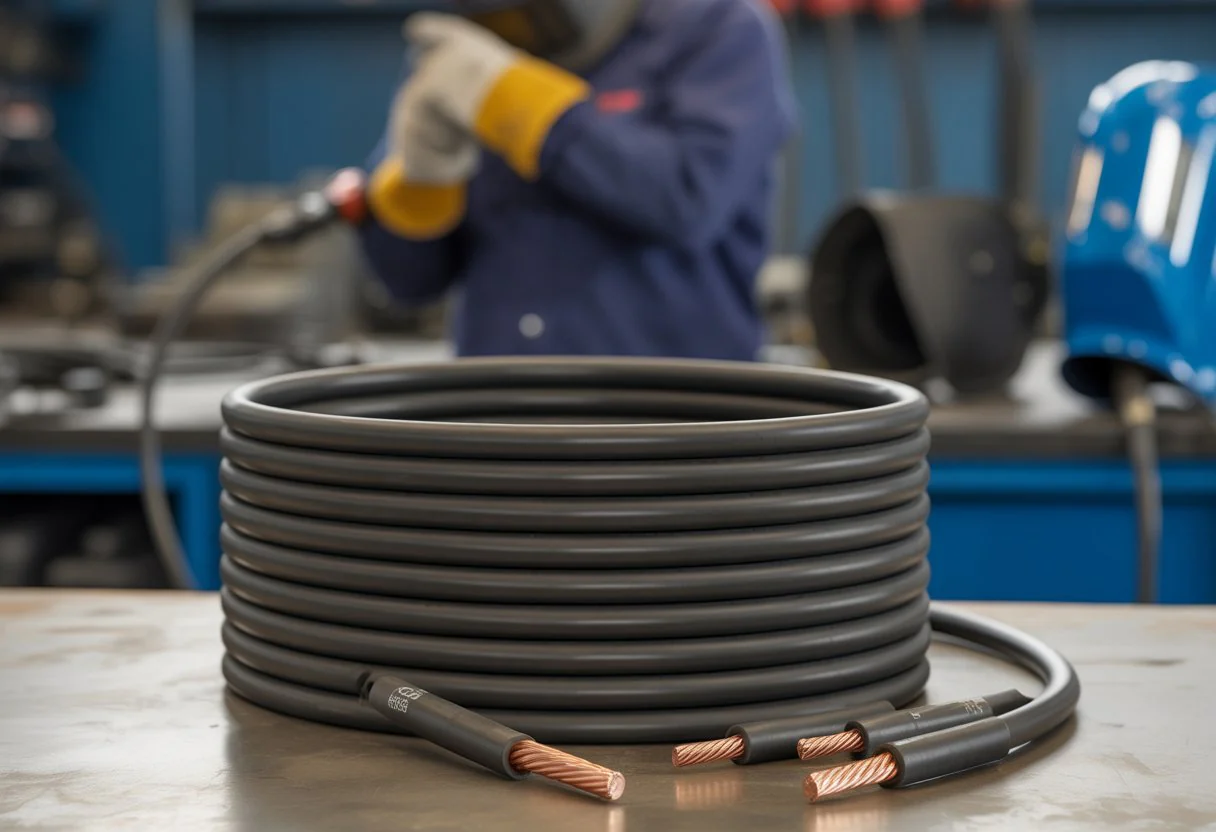
Here’s an example of a tightly coiled welding cable setup that can cause these exact problems:
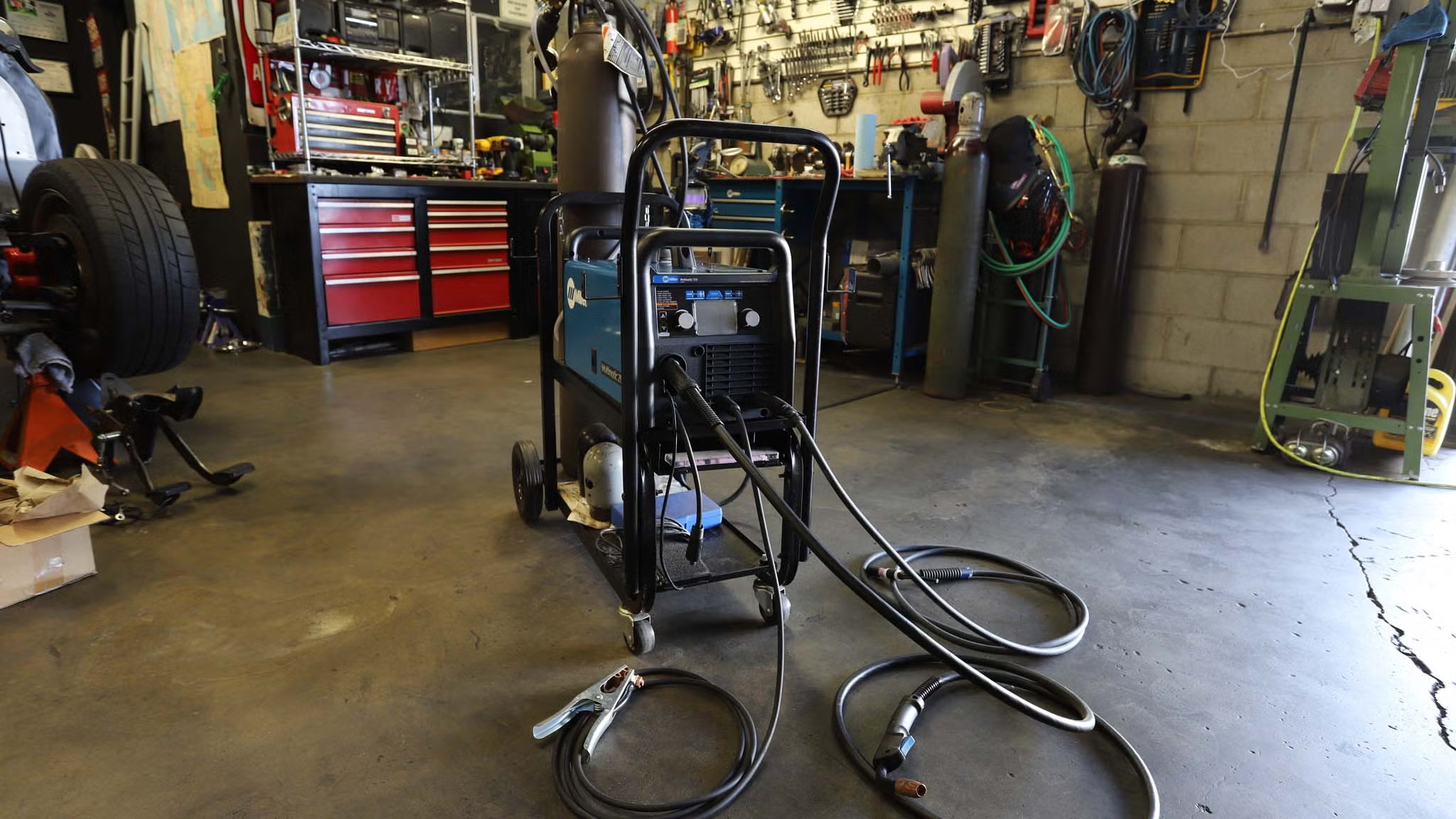
And a properly routed, uncoiled setup for comparison (notice how the cables are kept straight and supported):
Best Practices for Cable Length and Routing
- Choose cable length based on actual job needs — Measure the maximum distance from power source to work area, then add only 1–2 m extra for movement.
- Common recommendations:
- Shop/fixed station: 3–6 m torch cables, 10–15 m leads
- Field/pipe work: Up to 20–30 m leads (but upsize gauge to compensate)
- Common recommendations:
- Never weld with coils — Uncoil completely before starting. If excess length exists, lay it out in loose, wide loops (large radius) or hang it on a boom/sling.
- Use the shortest practical length — Shorter = less resistance, better arc quality, cooler operation.
- Upsize cable gauge if longer runs are unavoidable — Refer to manufacturer charts (e.g., for 200A, 35 mm² up to 30 m; larger for longer distances).
Quick Pre-Weld Cable Check
- Cables fully uncoiled—no tight coils or wraps
- Length appropriate for the job (no excessive slack)
- Routed straight or in gentle curves only
- No dragging on sharp edges or hot surfaces
- Test arc strike—should ignite easily and stay stable
Conclusion: Right Length, Right Routing = Reliable Welds
Excessive cable length or coiling is an easy-to-fix cause of unstable arcs, weak output, and hard starts. Always select the shortest suitable length for the task, uncoil fully, and route cables straight or gently curved. A few extra minutes of setup saves hours of fighting bad arcs and rework.
 English
  Español
  Русский
  العربية
  Français