

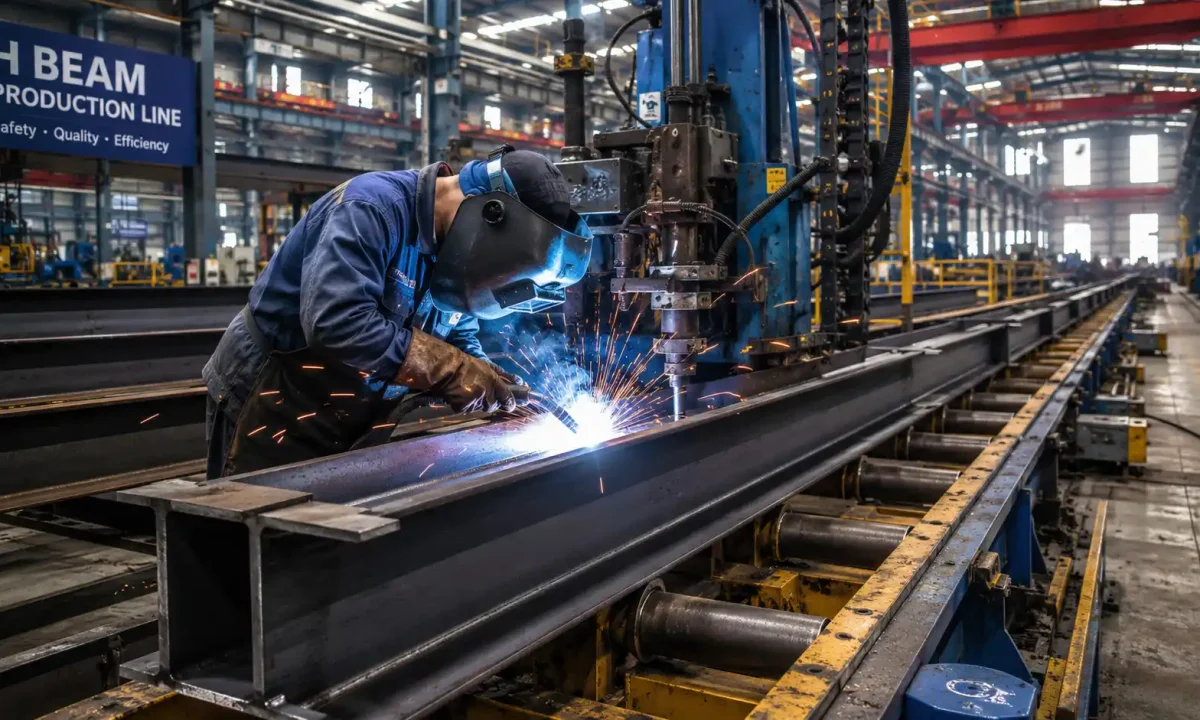
Сварка без фаски для двутавровых балок: как осуществляется сварка стенки толщиной 18 мм без подготовки паза
Введение
In H beam welding production, groove preparation has long been treated as a mandatory step. When web plate thickness exceeds a certain threshold, welding standards require the web plate edges to be machined into a beveled profile before welding begins — to ensure adequate weld penetration and structural integrity at the joint. This additional process adds equipment investment, extends production cycle time, and generates material waste on every piece processed.
Bevel-free welding changes this assumption. Through systematic optimization of welding parameters and torch configuration, modern H beam welding equipment can achieve full-penetration welds on web plates up to 18mm thick without any prior groove preparation — eliminating the beveling step entirely from the production process.
This article covers the industry background of groove preparation, the process logic behind bevel-free welding, its applicable range and limitations, and its practical impact on production workflow.
Краткое сравнение
| Размер | Conventional Groove Welding | Bevel-Free Welding |
| Groove preparation required | Yes | Нет |
| Additional equipment needed | Beveling machine or flame/plasma cutter | Нет |
| Production cycle per piece | Longer (includes groove preparation time) | Shorter |
| Material waste | Yes (metal removed during beveling) | Нет |
| Operator skill requirement | Выше | Нижний |
| Applicable web thickness | No upper limit | 18mm and below |
Why Groove Preparation Exists
The Weld Penetration Problem
The strength of a welded joint depends on weld penetration — the weld metal must fuse sufficiently deep into the base material to ensure the joint meets its mechanical performance requirements.
In H beam production, the connection between the web plate and flange plates is a fillet weld. For thinner plates — typically below 16mm — standard welding parameters deliver adequate penetration to ensure joint strength without special preparation. As web plate thickness increases, standard parameters can no longer reliably penetrate to sufficient depth. Incomplete fusion at the weld root becomes a risk, compromising the joint’s load-bearing capacity and fatigue life.
What Groove Preparation Does
To address this, welding standards require groove preparation on the web plate edge before welding — machining or cutting the edge into an angled profile that allows the welding torch closer access to the weld root, enabling greater effective penetration depth.
The Cost of Groove Preparation
Groove preparation appears to be a straightforward pre-processing step, but its costs accumulate across multiple dimensions. Dedicated equipment is required — beveling machines, flame cutters, or plasma cutters — each carrying capital cost and ongoing maintenance obligations. Every piece must pass through an additional process stage before welding can begin, extending the production cycle. The material removed during beveling is unrecoverable waste. And the quality of the groove preparation directly affects subsequent weld quality, introducing a skill-dependent variable into the process.
How Bevel-Free Welding Works
What Determines Weld Penetration
To understand bevel-free welding, it helps to first understand the parameters that control penetration depth in submerged arc welding:
- Welding current: The most direct penetration variable — higher current increases arc energy and drives deeper penetration
- Welding voltage: Affects arc shape and bead width, indirectly influencing penetration distribution
- Travel speed: Slower speed increases heat input per unit length, increasing penetration
- Wire diameter: Smaller diameter wire at the same current produces higher current density and greater penetration
- Torch angle: The angle of the torch relative to the workpiece determines where arc energy is concentrated, directly affecting effective penetration depth
The Parameter Optimization Logic
Bevel-free welding achieves full-penetration welds on 18mm web plates without groove preparation through systematic optimization of these parameters in combination. The core optimization directions are:
Higher welding current within the equipment’s capacity increases baseline penetration. However, excessive current raises heat input, increasing distortion risk — the optimization must balance penetration depth against distortion control.
Optimized torch angle positions the arc energy more directly toward the weld root rather than dispersing it across the bead surface. This is one of the key technical parameters that makes bevel-free welding achievable.
Matched travel speed increases heat input per unit length within production throughput requirements, complementing higher current to achieve sufficient penetration.
Appropriate wire specification selects smaller diameter wire to increase current density at the same current setting, further enhancing penetration capability.
These parameters are not optimized independently — they must be systematically matched to find the optimal balance point across penetration depth, distortion control, weld profile quality, and production efficiency.
Why 18mm Is the Current Technical Boundary
The reliable upper limit for bevel-free welding is currently 18mm web plate thickness. This boundary is determined by the physical limits of achievable penetration depth without groove preparation under production conditions. Beyond 18mm, reliable root fusion cannot be consistently guaranteed without beveling — and for heavier plate, the conventional approach of groove preparation followed by welding at lower heat input can actually deliver more reliable full penetration at lower overall cost. As welding technology and equipment capability advance, this boundary may extend further, but 18mm represents the currently engineering-validated reliable limit.
Applicable Range and Limitations
Where Bevel-Free Welding Delivers the Most Value
Factories with web plate thickness concentrated in the 12–18mm range represent the highest-value application window for bevel-free welding. This is the thickness range where conventional practice requires groove preparation but bevel-free welding can eliminate it entirely — the cost reduction is most direct and quantifiable.
Operations pursuing production line simplification benefit beyond direct cost savings. Removing one process step means one fewer machine, one fewer maintenance schedule, one fewer operator position to staff. For factories looking to reduce operational complexity, this has value beyond the economics of the step itself.
High-volume continuous production environments see the greatest cumulative benefit. The time saved per piece on groove preparation may seem small in isolation, but multiplied across daily output, it compounds into significant annual capacity release.
Limitations to Understand
Web plates thicker than 18mm cannot be reliably welded without groove preparation using current technology. Conventional groove preparation followed by welding remains the correct approach for heavier plate.
High-strength steel grades have different weldability and heat-affected zone characteristics compared to standard structural steels such as Q235 and Q345. Parameters validated for standard structural steel cannot be directly applied to high-strength grades — dedicated parameter development and validation are required before bevel-free welding is applied.
Weld quality verification requirements apply in applications with strict weld quality standards, such as bridge components or structurally critical members. Ultrasonic testing or other non-destructive examination methods should be used to verify root fusion, and appropriate quality validation processes established before bevel-free welding is adopted at production scale.
Production Impact
The Cascading Effect of Removing One Process Step
Eliminating groove preparation from the H beam production workflow triggers a chain of downstream simplifications. With beveling removed, web plates can move directly from cutting to assembly without routing through an intermediate processing station — reducing material handling steps and waiting time within the facility.
The absence of beveling equipment simplifies the plant layout, reduces the maintenance schedule, and narrows the spare parts inventory. The reduction in process complexity also lowers the skill threshold for the preparation stage — groove preparation quality control is an experience-dependent variable, and removing it raises the overall standardization level of the production line.
Quantified Benefit Reference
For a facility producing 30 H beams per day with web plate thickness primarily in the 14–16mm range, eliminating groove preparation saves approximately 15–20 minutes per piece in processing time. Across daily output, this amounts to 7.5–10 hours of recovered process time per day — equivalent to roughly 1,800–2,500 hours per year, or approximately 75–100 effective working days of capacity released annually.
These figures are simplified reference estimates; actual results vary by facility conditions. But the order of magnitude is real and provides a meaningful basis for evaluating whether the technology fits a given production context.
Заключение
Bevel-free welding technology has been engineering-validated for H beam production with web plate thicknesses up to 18mm and is now widely applied across modern H beam welding equipment. It is one of several process technologies covered in our Полное руководство по сварке и правке сборок двутавровых балок.
ZMDE has accumulated extensive field delivery experience with this technology across steel structure manufacturing operations in multiple countries. If you want to evaluate whether bevel-free welding is applicable to your web plate specifications and production conditions, contact the Техническая команда ZMDE for a process parameter assessment.

 English
  Español
  Русский
  العربية
  Français
  Português