

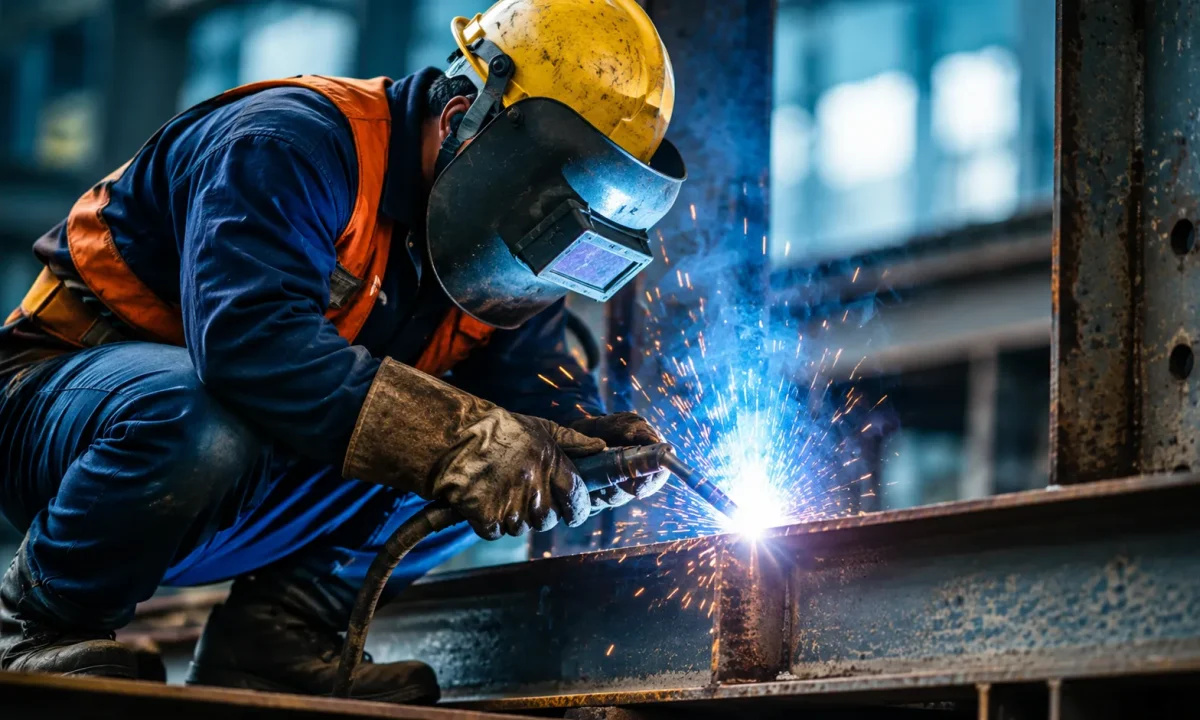
H Beam Assembly Welding Straightening Machine Complete Guide
مقدمة
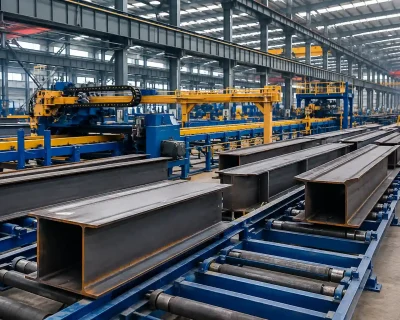
The H beam assembly welding straightening machine has fundamentally changed how structural steel beams are produced — integrating assembly, welding, and straightening into a single continuous process where three separate machines, three operator teams, and significant floor space were once required.
Traditionally, H beam production required three independent process stages, each carried out on dedicated machines with separate operators and significant floor space between stations. The logistical overhead alone added time, labor, and risk to every production run.
Today, this integrated equipment category represents the mainstream direction for automated H beam fabrication. This guide covers the core technology, cost logic, efficiency gains, and selection criteria to help both procurement decision-makers and technical engineers make well-informed choices.
Understanding the 3-in-1 H Beam Machine
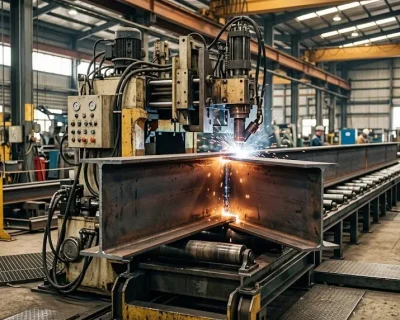
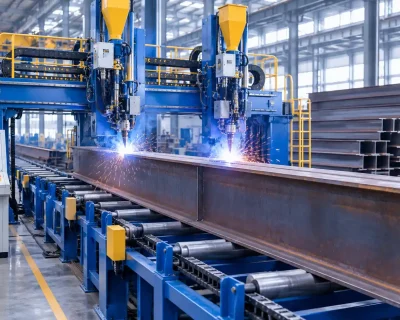
A 3-in-1 H beam machine integrates three traditionally separate processes — assembly, welding, and straightening — into a single piece of equipment that handles all three in sequence without manual intervention between stages.
The Production Process
The workflow follows a logical, continuous sequence:
- The web plate and flange plates are fed into the machine, where the assembly mechanism automatically positions and clamps them — no manual marking or alignment required
- The welding mechanism then performs simultaneous double-sided fillet welding along both flanges
- Immediately after welding, the straightening mechanism corrects flange angular deformation while the steel is still in an elevated temperature state
Why Integration Matters
The core value of the 3-in-1 design is not simply combining three machines into one footprint. It is the thermal continuity between processes — straightening begins while the steel is still hot from welding, when yield strength is lower and the material responds more easily to correction forces. This thermal window is only available in an integrated system where welding and straightening happen in immediate sequence.
Compared to separate machine configurations, the 3-in-1 approach delivers measurable advantages across floor space utilization, labor requirements, inter-process handling, and overall production throughput — each of which is covered in detail in the sections below.
Hot Welding and Hot Straightening Process
The Problem With Cold Straightening
Welding distortion is one of the most difficult quality variables to control in H beam production. When web and flange plates are joined by fillet welds, thermal stress causes the flanges to tilt inward — a deformation commonly referred to as angular distortion. Traditional cold straightening addresses this after the steel has fully cooled, requiring substantial mechanical force, higher energy consumption, and carrying the risk of incomplete correction or surface damage to the steel.
The Hot Straightening Process
The hot welding hot straightening process operates on a straightforward principle: correction is applied during the window immediately after welding, before the steel has fully cooled. At this stage:
- The steel retains higher ductility
- Yield strength is temporarily reduced
- The force required for correction is significantly lower
- The resulting geometry is more uniform and consistent
The 3-in-1 machine achieves this by precisely matching the distance and timing between the welding station and the straightening station, ensuring the steel enters the correction mechanism within the optimal temperature range.
Advantages Over Cold Straightening
Production data from integrated hot straightening systems consistently shows:
- Straightening force reduced by approximately 30–40% compared to cold correction
- Higher flange perpendicularity pass rates
- Extended service life of straightening rolls due to reduced mechanical stress
For factories producing large volumes of H beams with strict dimensional tolerances — such as steel structure fabrication centers and bridge component manufacturers — the hot welding hot straightening process is a critical technical specification to evaluate during equipment selection.
Bevel-Free Welding for H Beam
Groove Preparation Explained
In conventional H beam welding, when web plate thickness exceeds a certain threshold — typically 16mm or 18mm — welding standards require groove preparation (also called beveling) along the web plate edges before welding can begin. This ensures adequate weld penetration and structural integrity at the joint.
Groove preparation requires a dedicated additional process: either flame cutting, plasma cutting, or milling to create the required edge profile. This adds equipment investment, operator time, material waste from the removed metal, and an extra process step that extends the production cycle for every piece.
The Bevel-Free Welding Process
The bevel-free welding capability on 3-in-1 H beam machines achieves full-penetration welds on web plates up to 18mm thick without any prior groove preparation. This is accomplished through:
- Optimized welding parameters including current, voltage, and travel speed
- Precise torch angle configuration designed for deep penetration on flat-edge joints
التأثير على الإنتاج
Removing the groove preparation step from the H beam production process delivers concrete, measurable improvements:
- One fewer process step per piece, directly reducing cycle time
- Elimination of dedicated beveling equipment and its associated capital and maintenance costs
- Lower operator skill requirements for the preparation stage
- Reduced material waste from edge removal
For factories whose H beam production is concentrated in the mid-range web thickness spectrum — particularly 12mm to 18mm — bevel-free welding technology translates directly into quantifiable cost reduction per unit produced.
3-in-1 H Beam Machine Cost Comparison
Evaluating the Investment
The most common initial reaction when evaluating a 3-in-1 machine is that the upfront equipment cost appears higher than purchasing individual machines. This framing is misleading. A meaningful مقارنة تكاليف آلة تصنيع العوارض على شكل حرف H ثلاثية الوظائف requires looking at the full lifecycle cost of each configuration — not just the purchase price line item.
تكلفة شراء المعدات
The total acquisition cost of a three-machine separate configuration — independent assembly machine, welding machine, and straightening machine — is often comparable to or higher than an equivalent 3-in-1 system at the same production capacity. Each separate machine requires its own independent drive system, control system, and structural frame, which adds up quickly.
تكلفة المساحة الأرضية
Separate machine configurations require dedicated installation space for each unit, plus transfer aisles between stations. Total floor area required is typically 2 to 3 times greater than an equivalent 3-in-1 system. For factories with constrained floor space or facilities carrying significant rental costs, this difference directly affects operating economics.
تكلفة العمالة
Separate machine lines typically require three staffed operator positions — one per machine. A 3-in-1 system at higher automation levels can be monitored by one to two operators across the entire line. Over a multi-year production horizon, this labor differential is substantial.
Inter-Process Handling and Cycle Time Loss
Between each station in a separate machine configuration, finished pieces must be lifted, transferred, and repositioned — introducing crane waiting time, handling risk, and secondary alignment error. The continuous operation of a 3-in-1 line eliminates all of these inter-process gaps entirely.
Cost Comparison
| البعد المتعلق بالتكلفة | آلات منفصلة | آلة متكاملة 3 في 1 |
| شراء المعدات | متوسط – مرتفع | متوسط–مرتفع (مماثل) |
| المساحة المطلوبة | كبير | تم تخفيضه بنسبة 50–60% |
| Operators required | 3 positions | 1–2 positions |
| دورة الإنتاج | توقف مؤقت بين المراحل | مستمر |
| Straightening quality | Cold correction | Hot correction — superior result |
H Beam Fabrication Line Efficiency
Line-Level Efficiency
H beam fabrication line efficiency is not determined by the speed of any single machine. It is the product of total cycle time from assembly through straightening, floor space utilization, and labor productivity across the entire line. The 3-in-1 configuration improves all three dimensions simultaneously — a systemic gain rather than a single-point improvement.
Cycle Time Efficiency
In a separate machine configuration, inter-process transfers introduce cumulative idle time that is easy to underestimate. Each crane lift, repositioning, and realignment adds minutes per piece. Across a full production shift processing dozens of beams, this hidden downtime compounds significantly. The 3-in-1 line’s continuous in-line operation eliminates these gaps entirely, maximizing the proportion of time the steel is actively being processed.
Space Utilization Efficiency
Floor area is a fixed cost. The higher the output per square meter, the better the fabrication line’s economic performance. By consolidating three process stations into one footprint and eliminating inter-process transfer aisles, the 3-in-1 configuration frees 50–60% of the floor area that a separate machine layout would consume. This recovered space can be allocated to material staging, finished goods storage, or additional production capacity.
Labor Efficiency
Reducing from three operator positions to one or two is not only a labor cost reduction — it simplifies management, reduces coordination overhead, lowers error probability, and shortens onboarding time for new operators. Each of these factors contributes to sustained fabrication line efficiency over time.
For factories planning new production lines or evaluating capacity expansion, overall fabrication line efficiency should be weighted as a primary selection criterion — not an afterthought to individual machine specifications.
H Beam Flange Straightening Machine
An H beam flange straightening machine is purpose-built equipment for correcting angular deformation of H beam flanges after welding. It is available in two configurations on the market: as a standalone independent unit, and as an integrated module within a 3-in-1 system. Each serves a distinct operational context.
When to Choose a Standalone Unit
A standalone unit works best in three situations: factories that already operate separate assembly and welding machines and only need to add straightening capability without replacing existing equipment; operations that need to correct previously welded beams offline, such as clearing backlog or fixing pieces that failed dimensional inspection; and smaller-scale production where overall volume does not yet justify the investment in a full 3-in-1 system.
When to Choose the Built-In Module
The built-in module is the better choice in three scenarios: new production lines being planned from the ground up, where integrating straightening from the start eliminates the need for a separate machine footprint; operations that require hot straightening capability, since the built-in module corrects immediately after welding while the steel is still hot — a thermal window unavailable to standalone cold straightening machines; and factories looking to simplify maintenance and operations, as fewer machines means fewer independent maintenance schedules, fewer spare parts inventories, and a simpler operational environment.
Key Difference
Standalone flange straightening machines operate exclusively in cold correction mode. The performance gap between cold and hot straightening — in correction force required, geometric accuracy achieved, and roll wear rate — widens as production volume and beam specification consistency increase. For high-volume operations with concentrated beam specifications and strict tolerance requirements, the built-in hot straightening module delivers better long-term outcomes.
Selecting the Right 3-in-1 H Beam Machine
Selecting the right 3-in-1 system requires matching equipment specifications to your actual production profile. The key parameters to evaluate are:
Web Plate Height Range
The minimum and maximum H beam section height the machine can process. This determines whether the equipment covers your full range of beam specifications or only a subset.
Web and Flange Plate Thickness Range
The material thickness envelope the machine handles on both web and flange plates. Bevel-free welding capability — and its upper thickness limit — is particularly relevant here.
Welding Speed and Current Configuration
These parameters directly affect production throughput and weld quality. Higher current capacity supports thicker materials; welding speed determines how many pieces the line can complete per shift.
مستوى الأتمتة
Systems range from semi-automatic to fully automatic CNC-controlled operation. Higher automation levels reduce operator requirements and improve consistency but carry higher initial investment. Match the automation level to your labor cost environment and operator availability.
Hot Straightening Module Specification
Confirm whether the straightening module is standard or optional, and evaluate the correction force rating against your heaviest beam specifications.
When requesting quotations, ask suppliers to provide a side-by-side cost comparison between the 3-in-1 configuration and an equivalent separate machine layout based on your specific production volume, facility dimensions, and beam specification range. This comparison — grounded in your actual operating parameters — is the most reliable basis for an investment decision.
الخاتمة
The H beam assembly welding straightening machine represents the current standard for efficient, integrated H beam production. Whether the priority is reducing floor space, lowering labor costs, improving weld and straightening quality, or increasing overall line throughput, the 3-in-1 configuration has demonstrated its advantages across mid-to-large scale fabrication operations.
If you are evaluating whether a 3-in-1 system is the right fit for your production line, or need to make a decision between integrated and separate machine configurations, contact ZMDE technical team. We can provide specification recommendations and a detailed cost comparison based on your actual production data.
 English
  Español
  Русский
  العربية
  Français
  Português