

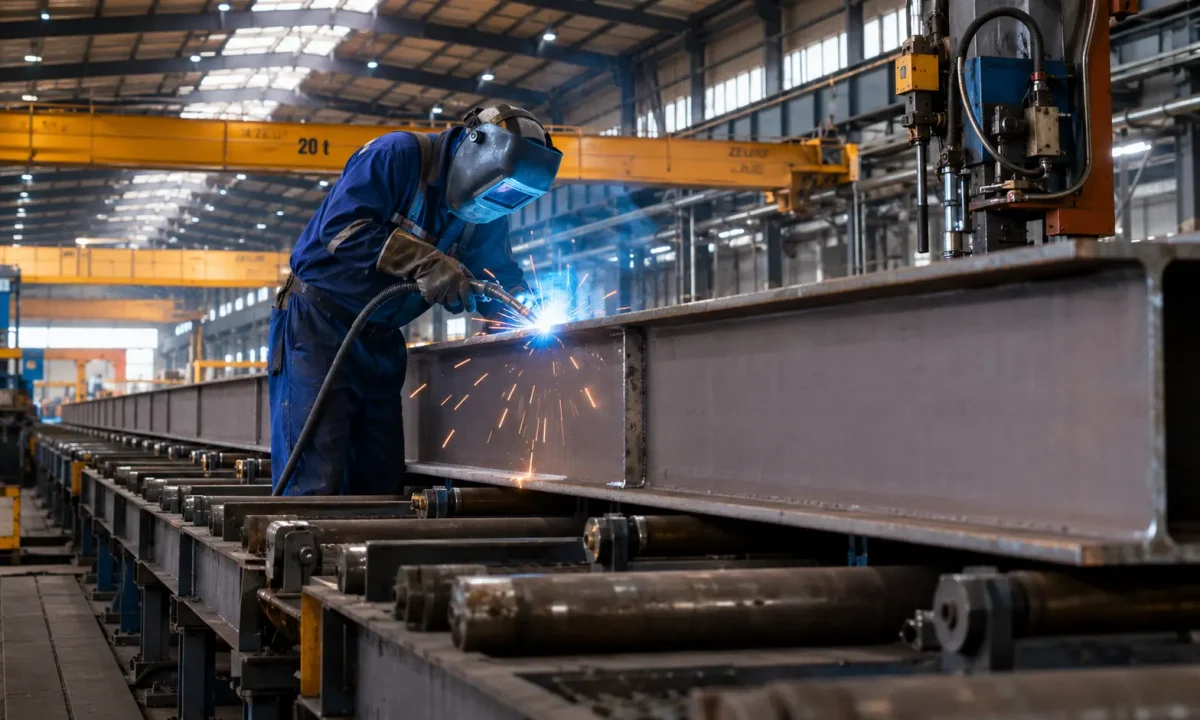
How the 3-in-1 Machine Improves H Beam Fabrication Line Efficiency
Introducción
In steel structure manufacturing, production efficiency is not just an internal management metric — it directly determines a factory’s order intake capacity, delivery timeline commitments, and competitive position in the market. An inefficient H beam production line does not just raise costs; it limits the scale of orders a factory can accept and the delivery terms it can offer.
Measuring H beam fabrication line efficiency requires looking beyond the speed rating of any individual machine. The relevant frame is system-level efficiency: the proportion of time the line is actively producing, output per unit of floor space, output per operator, and how these metrics collectively determine a factory’s actual delivery capacity.
This article analyzes how the 3-in-1 integrated machine improves H beam fabrication line efficiency across four dimensions: overall equipment effectiveness, space utilization, labor productivity, and delivery cycle performance. For a complete technical overview of the 3-in-1 system, see our H beam assembly welding straightening machine complete guide.
Quick Efficiency Comparison
| Efficiency Dimension | Separate Machines | 3-in-1 Integrated Machine |
| Productive time ratio | Lower (includes transfer waiting) | Higher (continuous operation) |
| Output per floor area | Low | High (50–60% less floor space) |
| Output per operator | Low (4–6 operators per shift) | High (1–2 operators per shift) |
| Inter-process waiting time | Present (crane transfers) | Eliminated |
| Delivery cycle stability | Affected by multi-machine coordination | Single-line management, more stable |
| Changeover response speed | Slow (three machines adjusted separately) | Fast (centralized parameter recall) |
Overall Equipment Effectiveness
Understanding OEE
Overall Equipment Effectiveness (OEE) is the manufacturing industry’s standard framework for evaluating production efficiency. It combines three dimensions:
- Availability: actual operating time as a proportion of planned operating time
- Performance: actual output rate as a proportion of theoretical maximum output rate
- Quality: conforming output as a proportion of total output
OEE = Availability × Performance × Quality
World-class manufacturing operations typically achieve OEE above 85%. Most factories operate between 60–70%, with the gap attributable to unplanned downtime, speed losses, and quality rejects. Understanding where losses occur is the starting point for improving H beam fabrication line efficiency.
How Separate Machine Configurations Constrain OEE
Each of the three OEE dimensions is structurally constrained in a separate machine layout:
Availability losses: any fault or maintenance requirement on any one of the three machines stops the entire production line. The cumulative failure probability across three independent machines is higher than for a single integrated unit, increasing unplanned downtime frequency.
Performance losses: inter-process crane transfers are pure performance losses. While the workpiece is being moved, lifted, repositioned, and realigned, all machines are idle — consuming planned operating time without producing output.
Quality losses: handling risk during crane transfers, secondary positioning errors, and the springback variability inherent in cold straightening all increase the probability of non-conforming output and rework.
How the 3-in-1 Machine Improves OEE
The integrated configuration improves all three OEE dimensions simultaneously:
Availability: a single equipment type with a unified maintenance schedule concentrates fault points and simplifies maintenance planning. Modular designs allow individual modules to be serviced without taking the entire line offline, reducing unplanned downtime duration.
Performance: continuous in-line operation eliminates inter-process transfer waiting entirely. The proportion of planned operating time spent actively processing steel increases substantially.
Quality: automatic positioning and clamping eliminates manual alignment error at the assembly stage. Hot straightening improves flange perpendicularity pass rates. The combination raises overall quality consistency above what separate machine configurations typically achieve.
Space Utilization and Output Density
Why Floor Space Efficiency Matters
Floor area is a fixed cost. Whether output is high or low, rent or depreciation continues to accrue. The higher the output per square meter, the more efficiently fixed costs are distributed across production volume — and the stronger the factory’s underlying cost competitiveness.
Comparing Space Utilization
For a line producing 12-meter H beams, a separate machine layout typically occupies 60–80 meters of longitudinal floor length. Including operating aisles and safety clearances, the total footprint runs approximately 600–1,000 square meters.
A 3-in-1 integrated machine typically occupies 25–35 meters of longitudinal length, with a total footprint of approximately 250–400 square meters — a reduction of 50–60%.
In a fixed facility, the floor area recovered by switching to an integrated configuration can be reallocated to:
- Raw material staging, reducing replenishment waiting time
- Finished goods storage, supporting larger-batch order fulfillment
- A second production line, directly expanding total throughput capacity
Recovered floor space is itself a latent capacity expansion resource — one that requires no additional facility investment to utilize.
Labor Productivity
Two Levels of Labor Impact on Efficiency
Labor configuration affects H beam fabrication line efficiency at two levels: direct output per operator, and indirect coordination overhead.
Direct level: a separate machine configuration requires four to six operators per shift across the three stations plus crane transfer personnel. A 3-in-1 system operates with one to two operators monitoring the entire line. At comparable output levels, the labor productivity differential is substantial.
Indirect level: multi-person coordination generates management complexity. Timing synchronization between stations, crane scheduling, and shift handover communication are all coordination costs. Any breakdown in coordination produces waiting time and throughput disruption at the line level.
Labor Productivity Reference
For a facility producing 20 H beams per day at approximately 2 tonnes per beam:
| Configuration | Operators per Shift | Daily Output | Output per Operator |
| Separate machines | 5 (midpoint) | 20 beams / 40 tonnes | 4 beams / 8 tonnes |
| 3-in-1 machine | 1.5 (midpoint) | 20 beams / 40 tonnes | 13 beams / 27 tonnes |
The labor productivity gap exceeds 3x at this output level and widens further as daily production volume increases.
Delivery Cycle Performance
What Constitutes Delivery Cycle Time
H beam delivery cycle time is not simply machining time. It includes raw material preparation and scheduling lead time, actual processing time across assembly, welding, and straightening, inter-process transfer and waiting time, quality inspection and rework time, and finished goods handling and dispatch preparation.
The 3-in-1 integrated machine has a direct impact on several of these components.
How the Integrated Machine Compresses Delivery Cycle
Eliminating inter-process waiting: removing the two crane transfers between assembly and welding, and between welding and straightening, directly reduces the elapsed time from material input to finished beam output on every piece.
Higher first-pass quality rate: the combination of automatic positioning and hot straightening reduces rework probability. Less time is lost at the quality inspection stage.
Simplified production scheduling: scheduling a single machine is fundamentally simpler than coordinating three independent machines. Scheduling errors and the waiting time they generate are reduced.
Faster changeover between specifications: switching between H beam specifications on a 3-in-1 machine requires recalling a preset parameter program. On a separate machine configuration, three machines must each be adjusted independently — changeover time is longer and the process is more error-prone.
Efficiency as Market Competitiveness
In steel structure construction projects, delivery timeline is frequently a primary procurement criterion. Factories that can credibly commit to shorter delivery cycles hold a meaningful advantage in project bidding. Factories that consistently fulfill delivery commitments build stronger long-term client relationships.
The efficiency improvements delivered by the 3-in-1 integrated machine ultimately translate into the ability to accept larger orders, commit to shorter delivery timelines, and fulfill those commitments more reliably. This is the market-facing value of H beam fabrication line efficiency — not just lower internal costs, but a stronger competitive position in the market the factory serves.
Conclusión
H beam fabrication line efficiency is a system-level question, not a single-machine specification. Across OEE, space utilization, labor productivity, and delivery cycle performance, the 3-in-1 integrated machine delivers improvements across every dimension simultaneously — not isolated gains in one area at the expense of others.
The cumulative effect of these efficiency gains is a factory with stronger order intake capacity and more competitive delivery terms. ZMDE’s 3-in-1 machines have been validated across steel structure manufacturing operations in multiple countries. If you want to assess the specific efficiency impact of the integrated configuration on your production line, contact the ZMDE technical team.
 English
  Español
  Русский
  العربية
  Français
  Português