

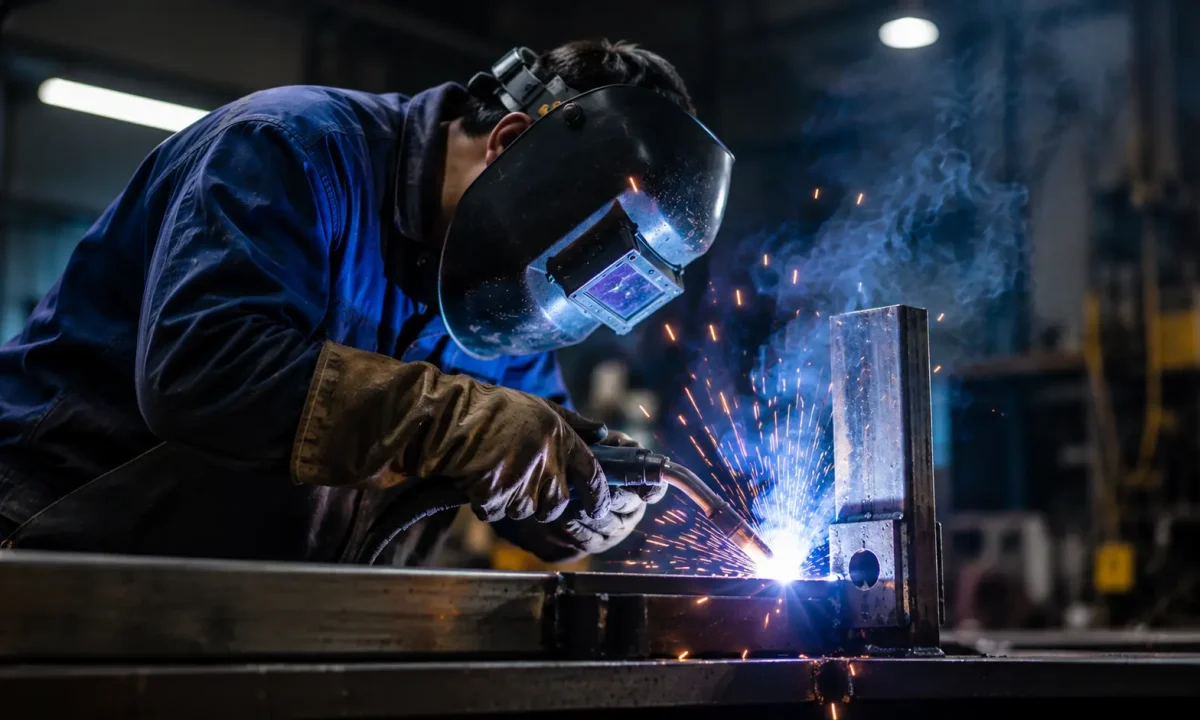
اللحام الساخن والتقويم الساخن: التكنولوجيا الأساسية للعملية داخل الآلة ثلاثية الوظائف
مقدمة
In H beam production, welding distortion is one of the most difficult quality variables to control. After the web plate and flange plates are joined by fillet welds, thermal stress causes the flanges to tilt inward — a deformation known as angular distortion. How efficiently and accurately this distortion is corrected determines the quality ceiling and throughput capacity of the entire production line.
Cold straightening has long been the dominant correction method, but its limitations in energy consumption, precision, and equipment wear have driven the industry toward a better solution. The hot welding hot straightening process fundamentally changes the logic of distortion correction — rather than waiting for the steel to cool and then forcing it back into shape, correction is applied during the optimal temperature window immediately after welding, achieving better results with significantly less force.
This article examines the physical basis, process logic, and practical advantages of the hot welding hot straightening process across four dimensions: the mechanics of welding distortion, the relationship between steel temperature and mechanical properties, a comparison with cold straightening, and how the process is implemented on a 3-in-1 integrated machine.
مقارنة سريعة
| البُعد | Cold Straightening | Hot Welding Hot Straightening |
| قوة التصحيح المطلوبة | مرتفع | Reduced by approximately 30–40% |
| Dimensional accuracy | Affected by springback, lower batch consistency | Minimal springback, high batch consistency |
| Straightening roll wear | Fast, shorter replacement cycle | Slower, extended service life |
| Energy consumption | مرتفع | أقل |
| Operator skill dependency | High — experience needed to compensate for springback | Lower — parameter-controlled |
| Best application | Offline correction, existing inventory | الإنتاج المتواصل على خط الإنتاج |
Understanding the Mechanics of Welding Distortion
To appreciate the value of the hot straightening process, it helps to first understand how welding distortion is generated.
How Residual Stress Forms
During H beam welding, the weld zone metal is heated to a molten state while the surrounding base material remains at a relatively lower temperature. As the weld cools and contracts, it is constrained by the cooler surrounding material and cannot contract freely. This creates residual stress in the weld zone and heat-affected zone, distributed unevenly across the cross-section. The result is that the flange plates tilt toward the web — the angular distortion that straightening is designed to correct.
Factors That Influence Distortion
The degree of angular distortion is influenced by several factors: welding heat input, the thickness ratio between flange and web plates, whether welding is performed on one side first or simultaneously on both sides, and the clamping and support conditions during welding. Understanding these factors clarifies why the timing of straightening — immediately after welding versus after full cooling — makes such a significant difference to the correction outcome.
Steel Temperature and Mechanical Properties
The hot welding hot straightening process is grounded in a fundamental physical property of steel: yield strength decreases as temperature increases. This is the physical basis for the entire process logic.
The Temperature-Yield Strength Relationship
At room temperature, common structural steels such as Q235 and Q345 have yield strengths in the range of 235–345 MPa. As temperature rises into the 200–400°C range, yield strength begins to decline noticeably. In the 600–700°C range, yield strength can fall to 30–50% of the room temperature value.
This means that applying a correction force while the steel is still at elevated temperature requires far less mechanical force to produce the same plastic deformation — and the corrected shape is retained once the steel cools.
The Hot Straightening Window
After welding is complete, steel temperature follows a gradient distribution outward from the weld zone and decreases continuously over time. The hot welding hot straightening process operates within the window where the steel is still at a meaningfully elevated temperature — typically within several minutes to roughly fifteen minutes after welding completes, depending on the beam specification, welding parameters, and ambient conditions.
Within this window, three conditions favor correction: yield strength is below the cold-state value, reducing the force required; ductility is higher, producing more uniform deformation without localized stress concentrations; and residual stresses have not fully stabilized, making the corrected geometry more durable.
Once this window closes and the steel approaches room temperature, the force required for correction rises sharply — and the limitations of cold straightening become unavoidable.
Hot Straightening vs Cold Straightening
Correction Force and Equipment Load
Cold straightening requires substantial hydraulic force to produce plastic deformation in fully cooled steel. This places high demands on the hydraulic system capacity and structural strength of the straightening equipment, driving up both equipment cost and energy consumption per cycle.
Hot straightening reduces the required correction force by approximately 30–40% compared to cold correction at equivalent beam specifications. This reduction lowers the hydraulic system load, reduces peak stress on the straightening rolls, and decreases energy consumption per piece — all without sacrificing correction quality.
Precision and Batch Consistency
A persistent limitation of cold straightening is springback. Steel at room temperature has a high elastic modulus, meaning a portion of the applied deformation recovers elastically once the correction force is released. To achieve the target geometry after springback, the applied correction must overshoot the target — a judgment call that depends on operator experience and varies between pieces.
Hot straightening produces significantly less springback. The combination of lower yield strength and reduced elastic modulus at elevated temperature means the corrected geometry is closer to the applied correction, and the shape is retained more reliably after the force is released. Flange perpendicularity pass rates and batch-to-batch dimensional consistency are both meaningfully higher compared to cold straightening, particularly in high-volume production with concentrated beam specifications.
Straightening Roll Service Life
Straightening rolls are the primary wear component in any correction mechanism. The higher forces required by cold straightening accelerate roll wear, shorten replacement intervals, and increase annual maintenance costs. The reduced correction forces in hot straightening produce a more favorable load profile on the rolls, extending their service life and reducing the frequency and cost of replacement.
Implementation on the 3-in-1 Integrated Machine
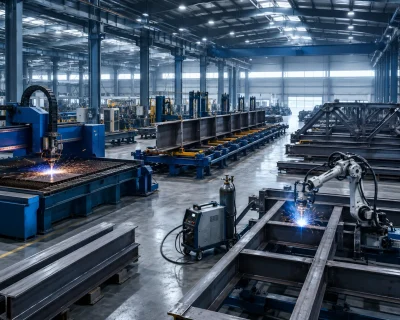
The hot welding hot straightening process only delivers its full advantage when welding and straightening are immediately sequential — with no cooling interval between the two stages. This is precisely where the 3-in-1 integrated machine provides a structural advantage that separate machine configurations cannot replicate.
The Problem with Separate Machines
In a separate machine layout, the workpiece must be crane-transferred from the welding machine to the standalone straightening machine after welding is complete. During this transfer — hooking, moving, landing, repositioning — the steel cools continuously. By the time the piece reaches the straightening station, the hot straightening window has typically closed, and the operation defaults to cold correction regardless of intent.
How the Integrated Line Solves It
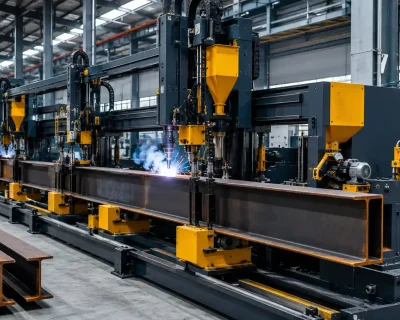
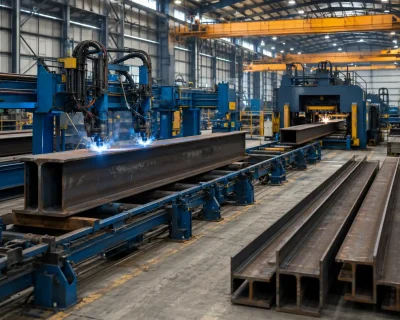
The 3-in-1 machine integrates the welding station and straightening station within a single continuous line. After welding, the workpiece advances directly to the straightening mechanism without any crane transfer. The distance between the two stations and the workpiece feed rate are engineered to ensure the steel arrives at the straightening mechanism within the effective hot straightening temperature range.
This immediate sequential integration is what converts the theoretical advantage of hot straightening into a consistent, repeatable production outcome. It is not possible to achieve genuine hot straightening with a standalone straightening machine — the process depends on the physical configuration of the integrated line.
Applicable Scenarios and Limitations
The hot welding hot straightening process delivers its strongest results in specific production contexts, and has limitations worth understanding before specifying equipment.
Where It Performs Best
High-volume continuous production with a concentrated beam specification range is where hot straightening delivers the clearest advantages — consistent parameters, repeatable results, and low correction force requirements combine to produce stable quality at low operating cost. Operations with strict flange perpendicularity tolerances, such as bridge fabrication or heavy industrial facility construction, also benefit significantly from the higher dimensional consistency that hot straightening provides.
Limitations to Consider
Hot straightening is only achievable through an integrated machine configuration — a standalone straightening machine physically cannot maintain the steel in the hot straightening window after a crane transfer. For previously welded beams that have fully cooled, cold correction remains the only available option. Additionally, high-strength steels have different temperature-property profiles than standard structural steels and may require adjusted parameters and process validation before hot straightening is applied.
الخاتمة
The logic of the hot welding hot straightening process is straightforward: it applies the physical fact that steel yield strength decreases at elevated temperature, correcting distortion at the moment when the least force is required and the best results are achievable. The technical challenge lies in building a production system where welding and straightening are immediately sequential — and that is the core process engineering value of the 3-in-1 integrated machine configuration. To understand how hot straightening fits within the full production sequence, see our complete guide to the H beam assembly welding straightening machine.
If you are evaluating straightening options for an H beam production line or want to understand how the hot straightening process applies to your specific beam specifications, contact the ZMDE الفريق الفني for detailed guidance.
 English
  Español
  Русский
  العربية
  Français
  Português