

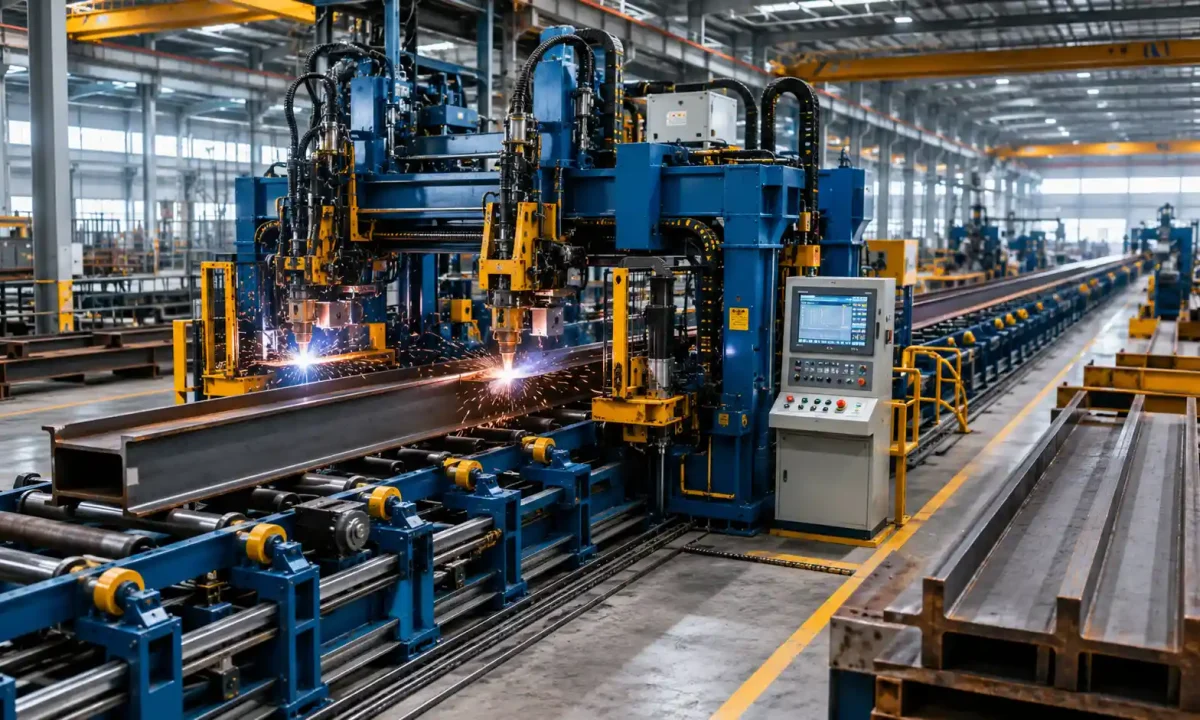
Comment la machine 3-en-1 améliore l'efficacité de la ligne de fabrication de poutres en H
A 3-in-1 H beam assembly welding straightening machine improves fabrication line efficiency primarily by eliminating inter-process transfer time and reducing the welding-line crew from 6–8 operators to 2–3, while maintaining throughput in the range of 500–800 tons per month for a standard single-shift configuration.
This article analyzes the efficiency gains across four dimensions that production managers use to evaluate line performance: cycle time and throughput, labor productivity, floor space utilization, and overall equipment effectiveness (OEE). All comparisons are between a 3-in-1 integrated machine and a conventional three-station setup (separate assembly machine, gantry SAW welding machine, and standalone flange straightening machine) of equivalent beam capacity.
| Efficiency Dimension | Conventional 3-Station Line | 3-in-1 Integrated Machine |
| Stations and transfers | 3 stations, 2 inter-process transfers | 1 station, zero transfers |
| Typical crew per shift | 6–8 operators | 2–3 operators |
| Floor space required | 3 stations + conveyors + buffer zones | 1 station + in/out conveyors |
| Typical monthly output (single shift) | 300–500 tons | 500–800 tons |
| OEE bottleneck | Transfer and re-clamping downtime | Welding speed |
How does a 3-in-1 machine reduce cycle time compared with a three-station line?
Cycle time per beam drops by roughly 30–40% when moving from a three-station layout to a 3-in-1 machine, with the majority of the saving coming from eliminated handling between stations rather than from faster welding.
Where does time go in a conventional three-station line?
In a conventional layout, the beam passes through three separate machines: the assembly machine tack-welds flanges to the web, the gantry SAW welder completes the fillet welds, and the flange straightening machine corrects angular deformation. Between each station, the beam must be lifted by overhead crane or roller conveyor, transferred to the next machine, re-positioned, and re-clamped. Each transfer-and-reclamping cycle typically consumes 8–15 minutes depending on beam length and crew coordination — and with two transfers per beam, that adds 16–30 minutes of non-productive time to every production cycle.
The total cycle time for a standard 12-meter H beam (web height ~800 mm, flange thickness ~16 mm) on a conventional line commonly runs 45–70 minutes, of which actual machining and welding time accounts for roughly 60–70%. The remaining 30–40% is transfer, waiting, re-clamping, and crane scheduling — time that produces zero output.
How does the 3-in-1 machine eliminate that non-productive time?
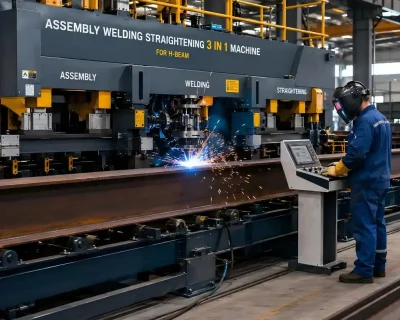
A 3-in-1 machine processes the beam in a single continuous pass: the beam enters, is assembled and tack-welded, moves through the SAW welding zone at a controlled travel speed (typically 1,500–2,000 mm/min for standard fillet welds), and exits with flanges already straightened. There is no crane lift, no re-positioning, and no re-clamping between processes. The beam touches the machine once and leaves finished.
This continuous-pass design converts the 16–30 minutes of inter-process transfer time into zero, and reduces total cycle time per beam to approximately 25–45 minutes depending on beam length and weld specification. For a fabricator producing 20 beams per day at roughly 2 tons per beam, that difference translates directly into additional daily output capacity.
Does the welding itself get faster?
The welding speed on a 3-in-1 machine is comparable to a standalone gantry SAW welder — both typically operate in the 1,000–2,000 mm/min range depending on wire diameter, current, and required weld size. The efficiency gain is not that the machine welds faster, but that the beam spends nearly 100% of its time on the machine being processed, rather than 60–70% being processed and 30–40% being moved.
How does a 3-in-1 machine affect labor productivity?
Labor productivity — measured as tons of finished beam produced per worker per shift — typically improves by a factor of two to three when switching from a conventional line to a 3-in-1 machine.
How many operators does each configuration require?
A conventional three-station line requires dedicated operators at each station: typically 2 at the assembly machine (one positioning, one tack-welding), 2–3 at the gantry welder (monitoring, wire feeding, flux management), and 1–2 at the straightening machine, plus at least 1 crane operator for inter-station transfers. That totals 6–8 operators per shift for the welding-to-straightening segment of the line.
A 3-in-1 machine consolidates this to 2–3 operators: one managing the assembly and feeding end, one monitoring the welding and straightening process, and optionally a third handling material staging. The crane operator role is eliminated entirely for this segment.
Why does this matter beyond payroll?
The labor impact goes beyond direct wage savings. Fewer operators mean fewer coordination points — and in a multi-station line, coordination failures (miscommunication at shift handover, crane scheduling conflicts, unbalanced pace between stations) are the most common source of unplanned downtime. A study from the Fabricators & Manufacturers Association (FMA) has noted that indirect labor costs in multi-station metal fabrication can add 25–40% on top of direct labor, driven by supervision, scheduling, and quality coordination.
The labor reduction also matters in the context of a global structural workforce challenge. The Indian Institute of Welding has estimated a shortage of 1.2 million welding professionals in India alone, and the American Welding Society projects a shortfall of 360,000 welding professionals in the United States by 2027. For fabricators who cannot hire the operators a three-station line requires, the 3-in-1 machine is not an efficiency upgrade — it is a prerequisite for running the line at all.
How does a 3-in-1 machine change floor space requirements?
A 3-in-1 machine typically occupies 40–50% less floor space than the equivalent three-station layout, and the remaining space becomes available for material staging, additional equipment, or a second production line.
What drives the floor space difference?
Three separate machines each require their own foundation, their own set of inlet and outlet conveyors, and buffer zones between stations for in-process inventory. A standard three-station welding line for 12-meter beams commonly occupies a bay of 60–80 meters in length and 8–12 meters in width. A 3-in-1 machine performing the same work fits within 30–40 meters of length — the inlet conveyor, the machine itself, and the outlet conveyor — with no buffer zones needed because there is no inter-process inventory.
When does floor space efficiency become a decisive factor?
Floor space efficiency becomes critical in two scenarios. In existing factories with fixed building dimensions, the space saved by a 3-in-1 machine can mean the difference between fitting a welding line into an available bay and needing to construct a building extension. In greenfield projects, a more compact line layout reduces building cost — structural steel fabrication workshops are typically priced per square meter of enclosed floor space, so a 40% reduction in line length directly reduces the capital cost of the building itself.
How does a 3-in-1 machine affect overall equipment effectiveness?
Overall equipment effectiveness (OEE) — the standard manufacturing metric combining availability, performance, and quality — typically improves from the 55–65% range common on conventional multi-station H beam lines to 75–85% on well-operated 3-in-1 configurations.
What limits OEE on a conventional line?
On a three-station line, the OEE bottleneck is usually availability — not because individual machines break down frequently, but because the line as a whole is only producing output when all three machines and the inter-station transfers are functioning simultaneously. If the straightening machine is waiting for a beam still being welded, or the welder is idle while the crane moves a beam from the assembly station, the line’s availability drops even though each individual machine may be technically operational.
This is the classic problem of line balancing in serial production: the throughput of the entire line is limited by its slowest station plus its longest transfer. Industry surveys suggest that multi-station fabrication lines commonly lose 15–25% of planned production time to inter-station waiting alone — before accounting for actual machine downtime, changeovers, or quality-related stoppages.
How does the 3-in-1 configuration improve each OEE component?
Availability improves because there are no inter-station transfers to cause waiting time and no crane scheduling to coordinate. The machine is either processing a beam or it is not — there is no “technically running but actually waiting” state. Unplanned downtime still occurs (power source issues, roller maintenance, consumable changeover), but the overall uptime fraction is higher because the largest single source of lost time has been structurally eliminated.
Performance — actual throughput as a fraction of theoretical maximum — improves because the travel speed of the beam through the machine is controlled by the welding process, not by the pace of the slowest station. On a conventional line, a fast welder paired with a slow assembly machine produces at the assembly machine’s speed. On a 3-in-1 machine, there is only one process speed to optimize.
Quality — conforming output as a fraction of total output — improves primarily through the hot straightening advantage. Because straightening occurs immediately after welding while the steel is still at elevated temperature, flange angular distortion is corrected with less force, more predictably, and with less springback than cold straightening. This reduces the rate of beams requiring re-straightening or rework, directly improving the quality component of OEE. For a detailed comparison of hot vs cold straightening, see our guide to standalone vs built-in flange straightening.
What are the limitations of a 3-in-1 machine for efficiency?
A 3-in-1 machine is not universally superior. Production managers should weigh three scenarios where the conventional layout may deliver better line-level efficiency.
High-volume lines with parallel processing needs
At production volumes above roughly 1,500–2,000 tons per month, a single 3-in-1 machine becomes the line bottleneck regardless of its cycle time advantage. At this scale, a conventional layout with two gantry welders running in parallel — each feeding a shared straightening station — can achieve higher total throughput than a single integrated machine. The breakpoint depends on beam specifications, but as a general rule, fabricators consistently running above 1,500 tons per month should evaluate parallel conventional layouts alongside a second 3-in-1 machine.
Very thick plate or oversized beam specifications
Standard 3-in-1 machines handle web plates up to approximately 30 mm and flange plates up to 40 mm. Beams exceeding these specifications — common in heavy bridge work and industrial crane girders — may require the higher correction force of a dedicated heavy-duty hydraulic straightening machine that exceeds the built-in straightening module’s capacity.
Facilities with existing serviceable equipment
If the assembly machine and gantry welder are relatively new and adequately sized, the efficiency gain from replacing them with a 3-in-1 machine may not justify the capital expenditure and production downtime during the changeover. In this scenario, adding a standalone straightening machine to the existing line is the more efficient path. For more on this decision, see our comparison of standalone vs built-in flange straightening.
Conclusion
The 3-in-1 H beam machine improves fabrication line efficiency across all four standard production metrics: cycle time drops 30–40% by eliminating inter-process transfers, labor productivity doubles or triples by consolidating 6–8 operators to 2–3, floor space shrinks 40–50% with no buffer zones needed, and OEE moves from the 55–65% range typical of multi-station lines toward 75–85%.
These gains are largest for fabricators producing 300–1,500 tons per month on a single line, processing standard-to-medium plate (web ≤ 30 mm, flange ≤ 40 mm), and operating in labor markets where crew availability is a constraint. Above 1,500 tons per month or beyond standard plate thickness, evaluate the 3-in-1 against parallel conventional configurations to find the right fit.
ZMDE manufactures 3-in-1 H beam assembly welding straightening machines across economy, standard, and heavy-duty configurations. Contact our engineering team with your beam specifications and current monthly tonnage for an efficiency comparison against your existing line layout.
 English
  Español
  Русский
  العربية
  Français
  Português