

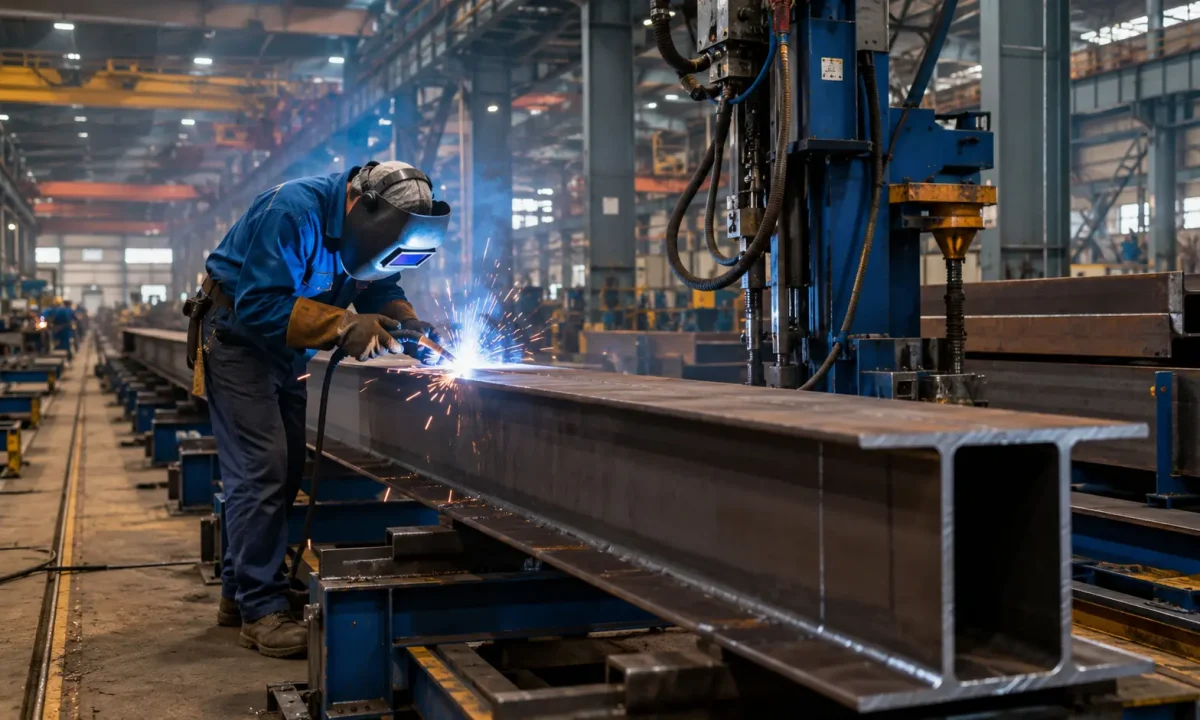
آلة تقويم حواف العوارض على شكل حرف H: الوحدة المستقلة مقابل الوظيفة المدمجة 3 في 1
مقدمة
After H beam welding is complete, correcting the angular deformation of the flange plates is the final critical step in ensuring finished product quality. The equipment responsible for this task — the H beam flange straightening machine — exists in two forms on the market: as a standalone unit sold independently, and as a built-in module within a 3-in-1 integrated machine.
Both forms share the same core correction principle, but they differ substantially in correction timing, process results, investment logic, and applicable scenarios. For factories planning their straightening capability, the choice between the two is not a simple price comparison — it requires a systematic judgment based on existing equipment, production scale, and quality requirements.
This article covers the working principle, a detailed comparison of the two forms, selection parameters for standalone units, and a scenario-based decision guide.
مقارنة سريعة
| البُعد | Standalone Flange Straightening Machine | Built-In 3-in-1 Module |
| Correction mode | Primarily cold straightening | Hot straightening (immediately after welding) |
| Correction force required | High | Low (reduced by approximately 30–40%) |
| Initial investment | Lower (single unit) | Higher (part of full system) |
| Applicable workpieces | Existing inventory, offline correction | Continuous in-line production |
| Floor space requirement | Independent installation area plus transfer aisle | No additional footprint (integrated in-line) |
| Compatibility with existing equipment | High (can supplement any line) | Requires full-line planning |
How a Flange Straightening Machine Works
The Correction Logic for Angular Deformation
After H beam welding, thermal stress causes the flange plates to tilt toward the web, producing angular deformation. Correction works by applying reverse pressure to the flange plates, producing plastic deformation that restores them to the perpendicular angle required by design.
The core mechanism of a flange straightening machine is a set of correction rolls:
- Horizontal support rolls carry the H beam from below, providing the reference base during correction
- Lateral straightening rolls apply pressure from the outside of the flange plates, pressing the tilted flanges back to the vertical position
- The hydraulic system delivers adjustable pressure to the rolls, accommodating different plate thicknesses and deformation magnitudes
As the workpiece passes through the roll assembly, the flange plates are corrected section by section, with the correction amount controlled through roll position and pressure parameters.
The Key Variables That Determine Correction Results
Three core variables determine correction quality:
Steel temperature — this is the fundamental difference between standalone units and built-in modules. The higher the steel temperature, the lower its yield strength, the less force correction requires, the smaller the springback, and the higher the achievable precision.
Correction pressure and roll positioning — insufficient pressure leaves the correction incomplete; excessive pressure risks local indentation or over-correction of the flange plates. Parameters must be matched to the workpiece specification.
Workpiece specification consistency — in batch production, the more consistent the specifications, the more reusable the parameters, and the more stable the batch-to-batch correction quality.
Standalone Unit vs Built-In Module: The Detailed Comparison
Correction Timing and Process Results
A standalone flange straightening machine processes workpieces that have typically cooled completely — whether transferred from a separate welding station or pulled from existing inventory. Cold steel has high yield strength, so correction requires substantially more force, and elastic springback is significant. The applied correction must overshoot the target based on operator experience, and batch consistency depends heavily on operator skill.
A built-in straightening module sits immediately after the welding station. The workpiece enters correction while still at elevated temperature, using the hot straightening window to achieve more stable results with less force — minimal springback, high batch consistency, and low dependence on operator experience.
This is a structural difference that no parameter adjustment can close — a standalone unit physically cannot access the hot straightening window.
Investment Logic
إن standalone unit carries a lower initial investment, suited to budget-constrained situations or operations that only need to add correction capability. Hidden costs deserve attention, however: independent installation space, crane capacity for workpiece transfer, dedicated operator staffing, and the higher roll wear inherent to cold correction.
إن built-in module is not sold separately — it is a component of the 3-in-1 integrated machine investment. Evaluating the module’s cost in isolation is not meaningful; it belongs within the framework of full-system return on investment, which is covered in the cost analysis comparing integrated and separate machine configurations.
Production Organization
Correction on a standalone unit is an offline process requiring independent scheduling, independent transfer, and independent quality records. Flexibility is its advantage — it can process workpieces from any source, including subcontracted pieces and historical inventory.
Correction in a built-in module is part of the in-line sequence. The workpiece flows from assembly infeed to corrected output without separate scheduling or handling. Efficiency is its advantage, but it can only process workpieces produced on its own line.
Selection Parameters for Standalone Units
If your situation calls for a standalone flange straightening machine, focus on these parameters during selection:
Applicable specification range — the H beam section height, flange width, and thickness range the machine can process. It must cover your primary product specifications with margin for future expansion.
Correction pressure rating — the hydraulic system’s maximum pressure determines the heaviest plate and largest deformation the machine can handle. Cold correction demands high pressure; specify with adequate margin.
Straightening roll material and hardness — rolls are the primary wear component. Material and heat treatment directly affect service life and replacement cost.
Feed method and speed — the drive roll speed range determines correction cycle time and must match your throughput requirements.
Parameter adjustment method — manual versus powered/hydraulic automatic adjustment affects changeover speed and the skill level required from operators.
Scenario-Based Decision Guide
When the Standalone Unit Is the Right Choice
Factories with existing assembly and welding machines — if correction is the only missing capability, adding a standalone unit is the minimum-investment path that leaves the existing layout untouched.
Operations with offline correction demand — welded-but-uncorrected inventory, or subcontracted correction work, makes the offline flexibility of a standalone unit a genuine requirement.
Production scale that does not yet justify a full-line investment — at smaller volumes, a standalone unit establishes complete process capability at minimal cost, deferring the full-line decision until capacity expansion demands it.
When the Built-In Module Is the Right Choice
New line construction or full-line upgrades — when planning from the ground up, the built-in module’s combined advantages in floor space, labor, and process results leave little reason to choose otherwise.
Product lines with strict quality requirements — bridge components, heavy industrial structures, and other applications with tight flange perpendicularity tolerances benefit directly from the batch consistency of hot straightening.
High-volume production with concentrated specifications — the combination of hot straightening and parameterized control delivers maximum efficiency in this context, with stable correction quality that barely depends on operator experience.
The Hybrid Configuration
Some factories run both: a 3-in-1 integrated machine handles in-line correction for the main production line, while a standalone unit processes subcontracted pieces, rework, and non-standard specifications. This hybrid configuration is not uncommon in mid-to-large steel fabrication plants — it captures efficiency and flexibility at the same time.
الخاتمة
The choice between a standalone H beam flange straightening machine and a built-in 3-in-1 module is fundamentally a trade-off between offline flexibility and in-line process quality. The standalone unit wins on investment threshold and compatibility; the built-in module wins on hot straightening, batch consistency, and full-line efficiency. To understand the built-in module’s role within the complete system, see our الدليل الشامل لآلة لحام وتقويم مجموعات العوارض على شكل حرف H.
ZMDE provides both standalone flange straightening equipment and 3-in-1 integrated machine solutions. If you are evaluating the right correction configuration for your production line, contact the الفريق الفني لشركة ZMDE for recommendations based on your current equipment and product specifications.
 English
  Español
  Русский
  العربية
  Français
  Português